Use StyleRoom for a while and you notice one thing: fitting shots always come out in pairs. You pick the one you like and use it. On the surface it looks like a simple convenience feature.
It is in fact one of the most deliberately designed pieces in this series. This article is about what sits behind the number two.
01 · No Answer Key
A generated image has no correct answer. With a maths problem you can mark the result, but for a fitting shot there is no reference sheet that says "this is the hundred-point photo."
Which is why the real hard problem for companies running generative AI is not generation but judgment. Which photo is better? There are metrics that try to automate this, and metrics are easily fooled. A sharper photo is not the same thing as a better photo, and a photo that resembles the original is not the same thing as a photo that sells.
Could we just ask people? At the Korea E-commerce Fair we learned something from 1,865 measured plays (Vol.08). People told our AI cuts apart from real lookbooks only 55.8% of the time. If telling real from synthetic is already that hard, "which one is better" is a harder question still, with taste mixed in. Paying people to score images is expensive, slow, and every labeler brings a different scale.
02 · Already Happening
And yet, look inside our own product and that difficult judgment is already happening every single day.
StyleRoom produces two photos for every fitting request. Same model, same garment, same conditions. The only difference is the randomness of generation. Then the user picks the one they prefer and uses it.
To the user this is just choosing. Seen through the lens of data, it is a perfectly controlled blind A/B judgment. Two outputs from the same input, compared seriously, at no cost to us, by the person who will actually put that photo to work. The judgment we would have received carelessly through a survey is made in earnest by a seller whose own revenue is on the line.
same conditions
randomness differs
actually uses it
recorded
How preference data accumulates. At no step is there a separate task called "labeling." The product running is itself data production.
03 · The Pair
The data that accumulates takes this shape: (same input, chosen photo, rejected photo). We call it a preference pair.
Preference pairs are powerful because they need no scale. "How many points is this photo?" wobbles, because everyone's scale is different. "Between these two, under identical conditions, which one?" needs no scale at all. The same holds for a model. Relative comparison under identical conditions is a far cleaner training signal than an absolute score. It is no accident that recent alignment techniques for generative models all stand on this shape of data.
We now hold tens of thousands of these pairs. The labeling budget spent making them was zero.
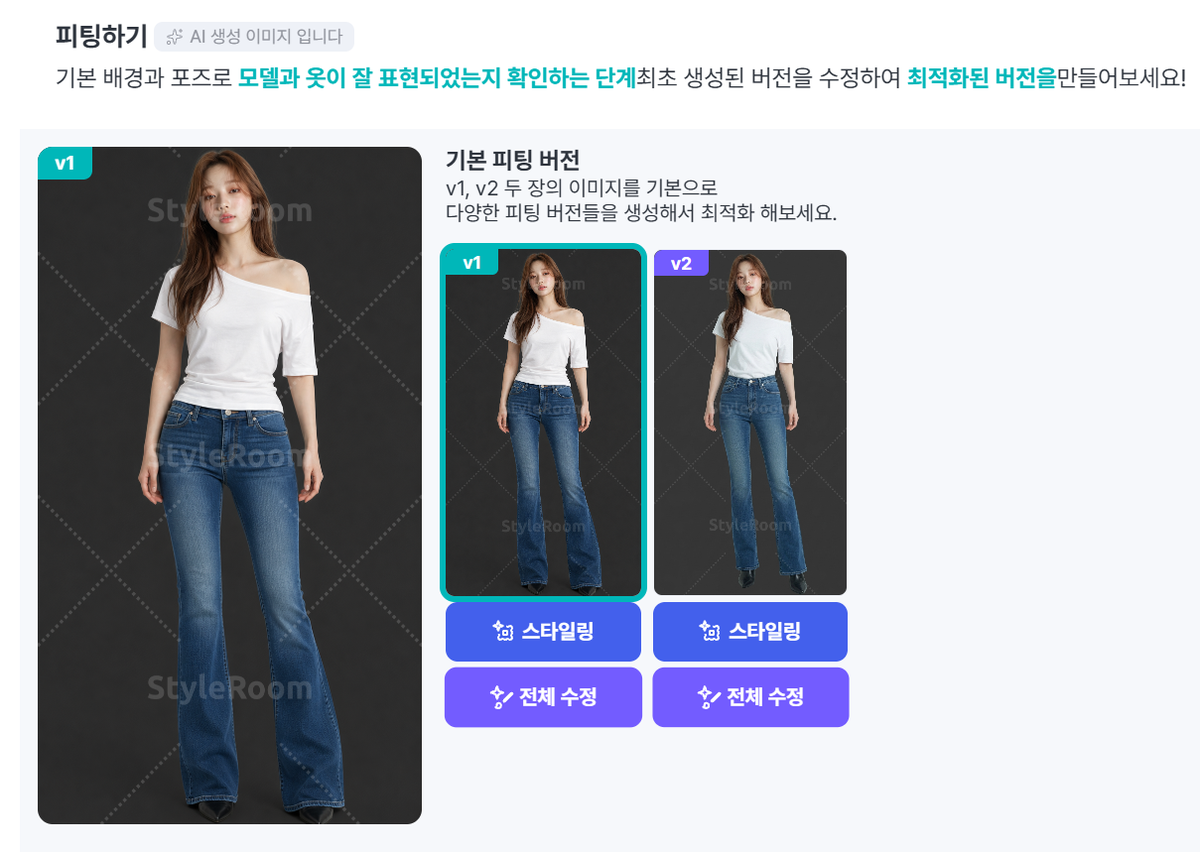
The actual fitting screen. v1 and v2, made from the same model and the same garment, sit side by side, and the user picks one before moving on to styling or editing. What gets saved at that moment is the single line above. It records not what was good, but what beat what. That is enough.
04 · By Design
In case this reads as "lucky us, the data piled up," let us be precise. This data was not found. It exists because we shaped the product so that it would. Three things have to hold.
- The two must come from the same input under the same conditions. Make one with today's version and one with last week's and the choice is unusable as a judgment. A choice between uncontrolled alternatives is noise.
- Choosing has to be the user's natural next step. The moment you ask someone to "please rate this for our data," response rate and sincerity both collapse. The judgment is honest only when the choice is something the user needs for themselves.
- It has to be two. Make one and there is no judgment at all. Make four and choosing becomes labor while generation cost doubles. Two is the smallest amount of freedom for the user, and the smallest structure in which a judgment exists for us.
05 · Handle With Care
To be honest, preference pairs are not a cure-all. A choice says "this one is better of the two," not "this photo is good." One gets chosen even when neither is satisfying. Taste and quality arrive mixed together, and the mind of a user who chose nothing never enters the record.
So we treat this data as a compass, not an answer key. Any single pair wobbles, but gather tens of thousands and a direction appears: which mistakes users refuse to forgive, and which differences they are indifferent to. That direction tells the next round of training where to spend its effort.
06 · Where It Goes
In Vol.09 we wrote about teaching a model "what to draw" - the 61 subcategory LoRAs. Preference pairs are the material for the step after that. They feed alignment training that teaches "which is better." When that training is done, we will come back with the results.
Compressed into one paragraph: a data moat is not collected, it is designed. The model generates. The user judges. And that judgment builds the next model.