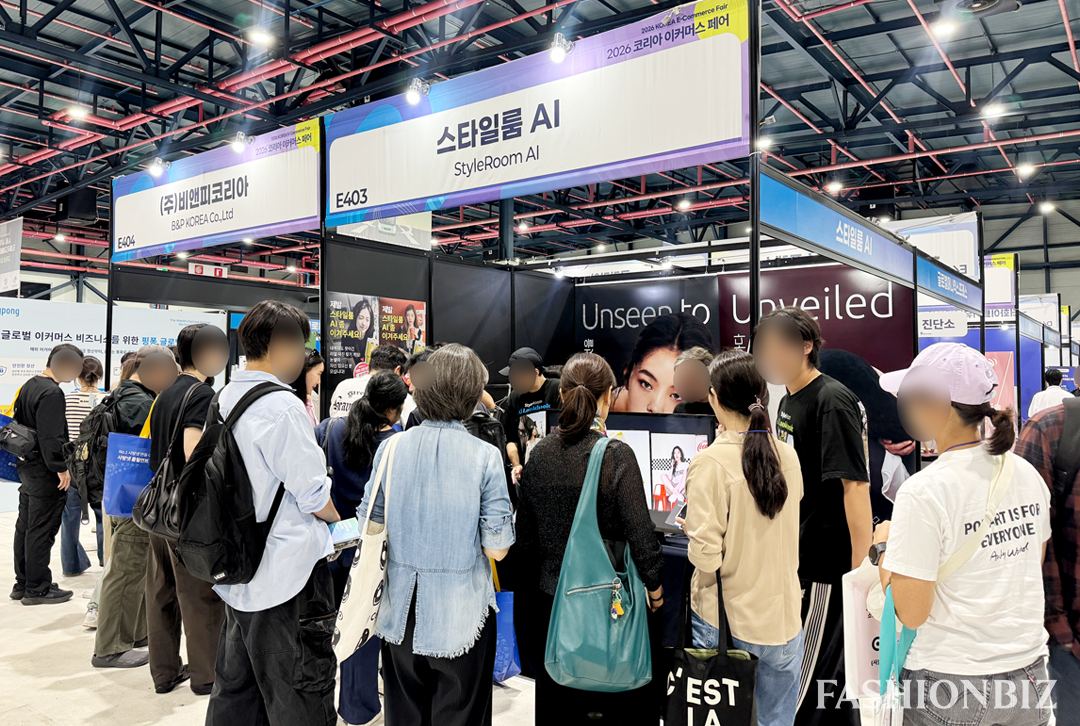
It's the first question sellers ask when they're thinking about bringing in AI images. StyleRoom got a chance to test it not in a lab, but on a floor packed with people: the Korea E-commerce Fair, held September 17 to 19, 2026, at SETEC in Seoul.
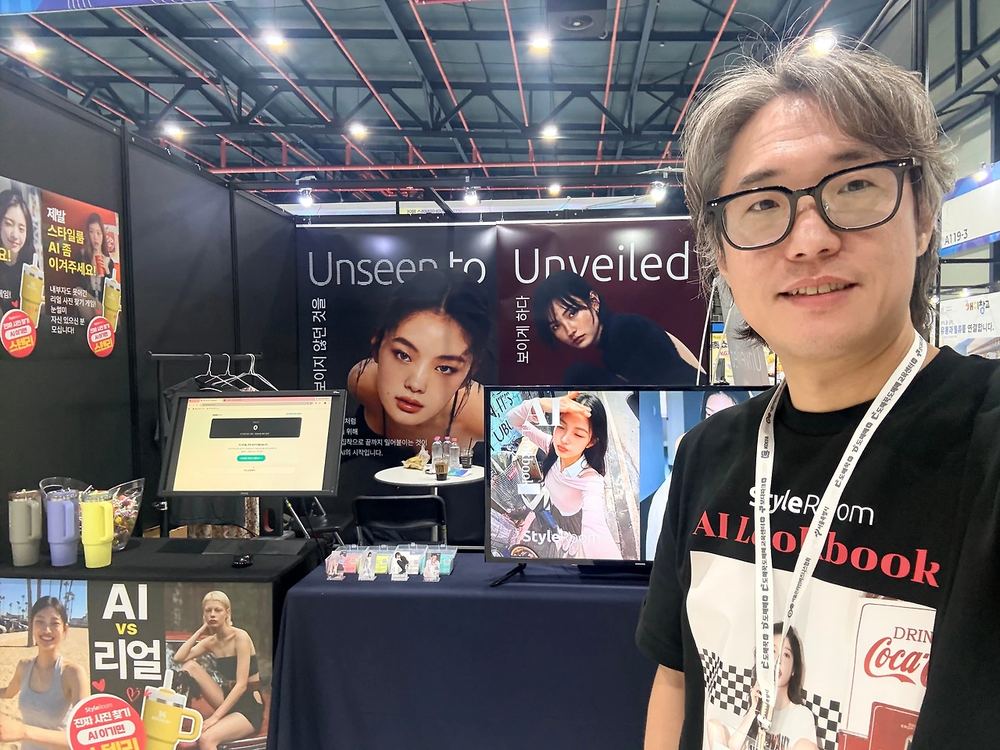
StyleRoom had attended conferences like AWS events, but had never run a booth at a trade fair. When the dev team asked what it could contribute, the answer was a game: a way to get people to come up to the booth, whatever it took.
We put that game at the center of the booth. It was called "Find the Real Photo." It mixed lookbook and model photos from brands on the market with photos StyleRoom had made, and asked players to pick out only the real ones. We expected 300 people over three days. The game was played 1,865 times.
And over those three days, we changed the game again and again. We removed the time limit and brought it back, lowered the target round from 10 to 6 and then to 5 on the last day, and added stamps and confetti. This piece reads through the records that piled up along the way. The interesting part: for all those changes, there was one number that never moved.
01 · The Game
The game used 648 photos in total.
- 235 lookbook and model shots from the market: brand lookbooks and model cut references shot in studios and on location
- 413 generated by StyleRoom: lookbook cuts made with the StyleRoom pipeline
Each round shows a mix of photos from the two groups, and the visitor has to pick only the real (market lookbook) photos. Get even one wrong and the game ends right there; get them all right and you move up to the next round. When the answer is revealed, a green border marks the real photos, and from the second day on, a "StyleRoom AI" stamp appeared on the AI photos.
| Round | Shown | Real to find | Chance of passing by guessing | Time limit |
|---|---|---|---|---|
| 1 | 2 | 1 | 50.0% | 17 s |
| 2 | 3 | 1 | 33.3% | 19 s |
| 3 | 4 | 1 | 25.0% | 21 s |
| 4 | 5 | 2 | 10.0% | 23 s |
| 5 | 6 | 2 | 6.7% | 26 s |
| 6 | 7 | 3 | 2.9% | 28 s |
The "chance of passing by guessing" is the probability of clearing a round by picking at random without looking at the photos. It's the baseline for this piece. If people can actually tell the photos apart, their pass rate should sit clearly above it. The time limits are the values after the adjustment on the morning of day one.
02 · The Crowd
We expected 300 people over three days. We printed 500 business cards to match, then printed 1,500 more and handed out all 2,000. The game ran around 600 plays on each of the three days.
the most of the three days
(median)
A 25-second gap between plays means that as soon as one play ended, the next one started with barely a pause. The records also work as an indirect measure of the crowd in front of the booth.
| Date | Busiest 30 min | Busiest hour | Shape of the day |
|---|---|---|---|
| Thu 9.17 | 10:30 · 66 plays | 14:00 · 111 plays | Two rushes: 10:30 a.m. and 2 p.m. |
| Fri 9.18 | 10:30 · 61 plays | 15:00 · 104 plays | Two rushes: 10:30 a.m. and 3 p.m. |
| Sat 9.19 | 10:30 · 12:00 · 70 plays each | 12:00 · 128 plays | 126 to 128 plays an hour from 11:00 to 13:00 |
On all three days, the busiest moment was 10:30, half an hour after the doors opened. On weekdays there was a second rush in the afternoon, and on Saturday the booth stayed full through the lunch hours.
"I looked it up, and it said this was the hottest booth at the fair, so I came."
Booth visitor"Young people were lining up to play."
Visitor review from day two · Naver Blog03 · Live Tuning
The game didn't end the way it was first designed. Watching visitors' reactions from beside the monitor, we kept changing it with two goals in mind: giving the best possible experience right there on the spot, and leaving the name "StyleRoom AI" in people's heads. Every change went live during the fair.
| Deployed | What we changed | Why |
|---|---|---|
| Before openingDesign | Prizes for clearing, not for ranking. A Stanley tumbler for everyone who cleared the target round. Photos at full original resolution, with the next round preloaded | Prizes were based on clearing a round from the start, and shrinking the photos would blur the details needed to judge them |
| 9.17 10:40Day one | Time limit briefly turned off, and instant retry after losing. Removed the result screen so one button restarts from round 1 | The venue internet was slow, so the timer ran down while photos loaded, and we wanted people to be able to try again right after losing |
| 9.17 10:57Day one | Time limit restored at 1.5× the default (round 1: 11 s → 17 s) | Instead of removing the time limit altogether, we decided to bring it back with more room |
| 9.18 10:13Day two | Target round 10 → 6, confetti for clearing the whole game, a StyleRoom QR code on one side of the screen, zoom button removed | No visitor reached round 10 on day one |
| 9.18 10:19Day two | An "Out!" stamp in the center of the screen after a wrong pick | To make the moment of losing clearer on screen |
| 9.18 10:36Day two | A "StyleRoom AI" stamp on the AI photos when the answer is revealed | To show at a glance which photos were AI, and that StyleRoom made them |
| 9.18 11:21Day two | A diagonal "StyleRoom AI" watermark in the background | In rounds with few photos, the white space looked empty |
| 9.19Last day | Target round 6 → 5 (applied through on-site operation), first Stanley tumbler winner | Round 6 was still too high a bar for visitors |
The deployed time is when the code went up. The booth devices only picked up the new version after a refresh, so the screens actually changed a little later than this.
04 · The Constant
With this many changes, we can slice the records at each change. The first thing we checked was the round 1 pass rate: picking the one real photo out of two, the easiest round in the game.
original
65 playsNo time
limit
38 playsTime
limit 1.5×
493 plays6 rounds
+effects
597 playsSaturday
5 rounds
672 plays
Removing the time limit, stretching it to 1.5×, lowering the target round and adding effects, even the weekend: none of it moved the round 1 pass rate much from around 55%. Split by day, it's 57.0% · 54.7% · 55.7%.
What we changed was the flow and the mood of the game. We cut the waiting, made losing clearer, and added touches that left our name behind. But the fact that it's hard to tell which photo is real when two sit side by side didn't change with any of it. The one thing in this game that never changed was the photos themselves.
05 · Result
(1 real out of 2)
with eyes closed
round 1
Across all three days, the round 1 pass rate was 55.8%. That's only 5.8 percentage points above picking at random. More than four times out of ten, people picked the StyleRoom cut as the real lookbook. The line we heard most at the booth was "Is this one really real?", and it wasn't unusual for a whole group to try together and all go out in the first round.
With 55.8% over 1,865 plays, the 95% confidence interval is 53.5 to 58.0%. It's clearly above random (50%), so people weren't entirely without clues. But the gap is about 6 percentage points, too small to call an ability to tell them apart.
06 · The Few
In rounds 2 and 3, too, pass rates were only about 7 percentage points above guessing. Things change from round 4. In round 4, where you pick 2 out of 5, the pass rate was 25.7%, more than double the guessing rate (10.0%).
But only 136 plays reached round 4, and those were people who had already gotten three rounds right in a row. They were a sharp-eyed few, filtered up from the rest. Even for them, the bar was high. Not a single visitor cleared round 6 (3 out of 7) in three days, and the first tumbler winner only appeared after we lowered the target to round 5 on the last day.
07 · What People Asked
The questions we got most often at the booth tie back to the question of this piece: can people recognize AI photos?
- "How is this different from other AI tools?"
This came from people who had used AI images themselves. It was the hardest one to answer in words, and in fact many people convinced themselves by watching the lookbook images and videos looping on the booth monitors, saying "the quality here is high." - "Do I need photos of the clothes?"
Yes. StyleRoom starts from photos of the clothes you actually sell. - "Do you make the product page too?"
No. We make the images and videos that go on your product page.
08 · Conclusion
The market photos in the game were lookbooks and model cuts shot in studios and on location: the kind of results sellers would hold up as the standard for "well-shot photos." Next to them, we placed cuts made by the StyleRoom pipeline.
At a venue full of online sellers, looking at two photos side by side under the best possible conditions, the result was 55.8%. We changed the game's rules and effects many times over three days, but this number stayed put. At this fair, StyleRoom cuts were accepted as the same kind of photo as market lookbooks.
Shoppers on a product page usually look at photos for less time than game players did, and on smaller screens. If players couldn't spot the difference even when their task was literally "find the real one," a shopper scrolling down the page is even less likely to notice it.
- We didn't touch the resolution. Shrinking the photos would blur the details needed to judge them, and the game wouldn't work. We kept the original dimensions and only switched the file format to WebP, cutting a 3.8 MB original down to about 990 KB.
- We preloaded the next round. While a player worked on one round, the photos for the next round downloaded first, cutting the wait between rounds.
- We kept saving from blocking the game. Each play leaves a record when it ends, but the next play starts right away without waiting for the save to finish. That way "Try again" doesn't stall, even on a slow connection.